
There’s been a tonne of conversations about em dashes over the last few years, most of it making the connection between using an em dash and content having been generated by AI.
But here’s everything you didn’t know about em dashes – and dashes in general – and didn’t know you didn’t know.
Hopefully, this will help make the conversation a little clearer!
There are three types of ‘dash’
Well, technically, only two of them are dashes. But we’ll come back to that.
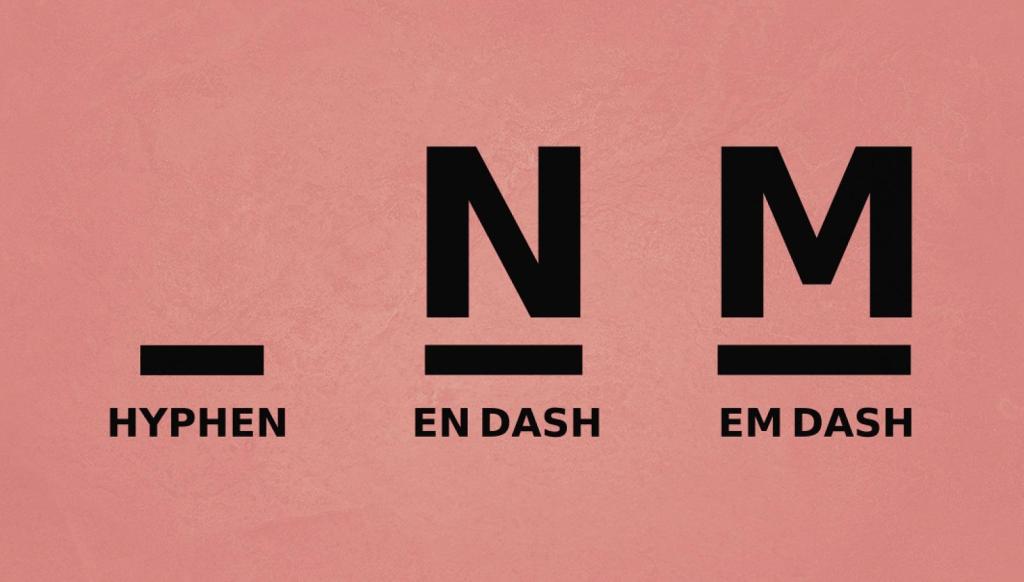
There are three little horizontal marks that you’re likely to encounter in your writing:
- the hyphen (-)
- the en dash (–)
- the em dash (—)
What’s the difference?
Hyphens
We all know and love/hate the hyphen.
It’s used for – literally – hyphenating words, and is often (mis)used for number spans. It’s the most commonly and easily used of the three. There’s literally a key for it on every keyboard!
Hyphens are used to join words or parts of words: well-known, user-friendly, long-term, decision-making.
They’re not generally what you want when you’re showing a range of numbers or dates. That’s where the en dash comes in.
En and em dashes
The en dash and em dash (sometimes historically called the en rule and em rule – see what I did there?) are typographic dashes.
The en dash is the same length as the letter n in the font you’re using, and the em dash is the same length as the letter m.
That’s literally how they got their names.
So, what are the en and em used for?
En dashes
En dashes are commonly used without spaces for number spans:
- 15–20 years
- 2016–18.
They’re also used to show a linking or connecting relationship:
- Manawatū–Whanganui
- teacher–student interaction
- New Zealand–Australia relations.
And in many places, including Aotearoa New Zealand, en dashes are also commonly used with a space on each side as a parenthetical dash – like this – to indicate an aside.
You could choose to use brackets instead, but you’ve chosen not to. I sometimes think of brackets as indicating a more definitive break for the aside, which you may or may not want – but either is a valid style choice.
And I can’t emphasise this enough: there is nothing wrong with using a dash like this.
Depending on the style of writing you’re doing, of course. To be fair, there may well be something very wrong with it if you’re writing a formal legal or financial report to a government minister, but generally speaking, you’re good.
How do you make an en dash?
There are several ways:
- hold down the Alt key on your keyboard and type 0150 on your number pad
- hold down Ctrl and press the minus (-) key on your number pad
- in Word, type space, hyphen, space and then the next word; when you press the space bar again, your hyphen will change to an en dash.
Or, of course, you can just copy one from somewhere else. I won’t tell anyone.
Em dashes
And the em dashes?
They can also be used—without spaces on either side—to show a parenthetical aside.
However, in Aotearoa New Zealand, this is relatively uncommon – not least because not many people know how to generate an em dash and Word doesn’t create them by default when you’re typing.
So – particularly in US writing – you might see em dashes used like this:
- This is an aside—and this is the end of it.
You can generate an em dash by:
- holding down the Alt key on your keyboard and typing 0151 on your number pad
- holding down Ctrl and pressing the minus (-) key twice on your number pad.
So what’s all this got to do with AI?
This is where things get interesting.
AI tools have largely been developed in a North American context, where em dashes are commonly used for parenthetical asides. As a result, AI-generated content will often use em dashes unless you specifically tell it not to.
And that can be noticeable to a New Zealand audience.
If you’re used to seeing an en dash with spaces – like this – and suddenly you see em dashes without spaces—like this—you might think it looks a little unusual.
That’s where the whole “em dash = AI” conversation has come from.
But an em dash does not prove that something was written using AI.
Nor does using a dash mean you’re doing anything wrong.
It simply means that someone has chosen a particular style – and that style may be more or less common depending on where they’re from, what they’re writing and what style guide they’re following.
Choose your dash style – and stick to it!
Whether you use en dashes or em dashes for parenthetical asides is, ultimately, a matter of style.
The key thing is to be consistent.
Once you’ve made a choice, stick with it – at the very least for that document. Most organisations will have a chosen organisational style and will expect you to follow it for the documents you create for them.
And if you’re using AI to help you write, it’s worth knowing what your organisation’s style is and telling your AI tool to follow it.
But if you’ve always used a dash to create an aside in your writing?
Keep using it. You’re not wrong.
Just know that if you choose to use an em dash, some people may assume your writing has come from AI. Now you know all about ems and ens, you’ll be able to explain it to them. 😉

